
By Dr. Mykhaylo Mokiyenko, Editor
At the end of 2025, the English-language edition of the collective work “History of Pentecostalism in Ukraine” was published to commemorate the 100th anniversary of the Movement of the Spirit. Amid the large-scale military confrontation provoked by Russian aggression, the book serves as a powerful reminder of God’s mighty work in Eastern Europe during the twentieth century.
Despite its rather long history, the Pentecostal movement in Ukraine remains insufficiently studied. This is primarily due to the nature of Pentecostalism with its emphasis on orality, as well as the Soviet atheist experiment that forced believers to struggle for survival and made historical research impossible. In independent Ukraine, the movement was significantly renewed through emigration and the rapid influx of new converts, who are generally less interested in the earlier stages of Pentecostal history. However, in recent years, thanks to access to archival materials from the Soviet era, including previously classified files, Pentecostal historical studies have gained new momentum.
The publication focuses on the main Pentecostal traditions. They appear as a kind of “movement of movements” that arose through the interaction of Western theological influences, indigenous spiritual quests rooted in mystical currents both within and beyond dominant church traditions, and the spiritual aspirations of Evangelical Christians and Baptists. A short period of organic development of Ukrainian Pentecostalism was artificially halted by prolonged Soviet persecution. This had a notable impact on elements of Pentecostal identity but did not fully deform it. The regional specificity of the Ukrainian movement is highlighted in sections devoted to Bukovyna and Transcarpathia.
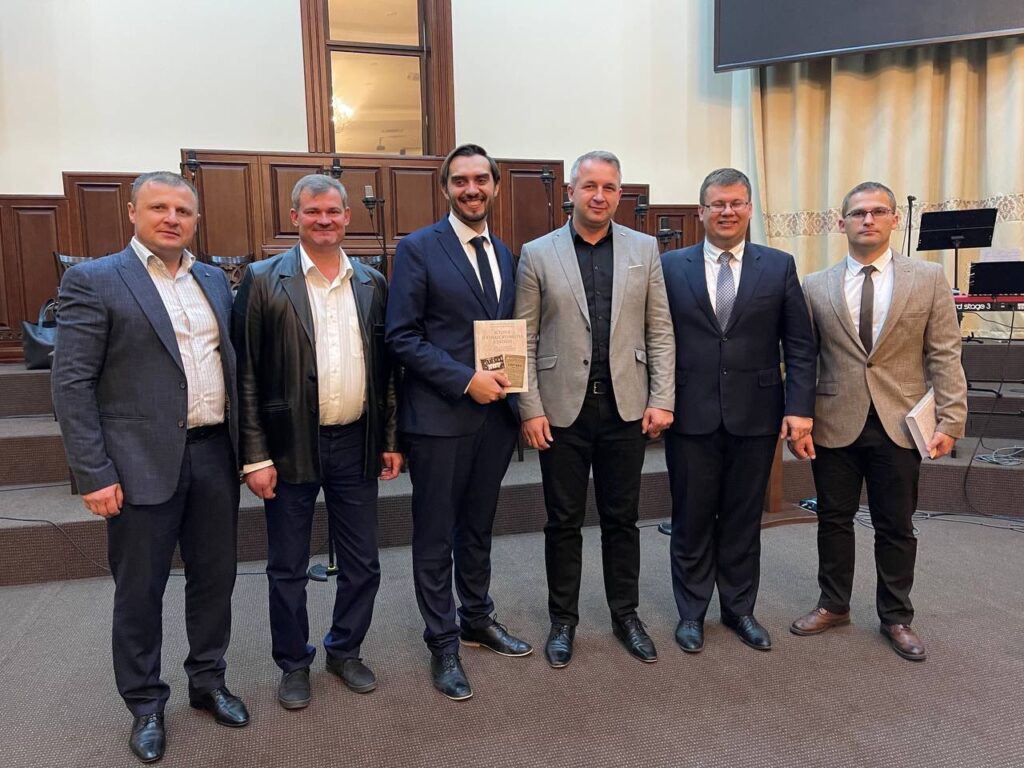
The authors with the Ukrainian version of the book
The book is divided into three parts covering the origins, consolidation, and historical transformations of Pentecostalism. It begins with an analysis of the movement’s emergence and development abroad and continues with a description of its organic adaptation within the Ukrainian context. Considerable attention is given to key founders of the movement, especially Ivan Voronaev. To better understand the contextual influences on Ukrainian Pentecostalism, the publication provides a detailed account of the political and legal realities of the Soviet Union and the factors that enabled believers to survive during difficult times. The upper chronological boundary is set at the end of the Soviet era.
Among the key substantive conclusions of the study are the following:
-
Mission is the central activity of Pentecostals in Eastern Europe. The first generation of Pentecostals was determined to restore the passionate missionary vision of Christianity, interpreting, on the basis of the Acts of the Apostles, their own spiritual experience as a potential for fulfilling the mission.
-
The scale of revival is proportional to the price paid for it. Acknowledging that the main price was paid by Christ at Calvary, believers in Ukraine were ready to offer their own sacrifice to advance the Kingdom under hostile ideological and political conditions.
-
Even when freedom is limited, time must be used as effectively as possible. Short periods of restricted religious freedom in the twentieth century were marked by increased Pentecostal activity expressed in evangelism, the development of local congregations, and inter-church fellowship. This was the case in the 1920s in Soviet Ukraine, during the German occupation in the 1940s, and in the “Khrushchev Thaw” of the mid-1950s. The spiritual resilience gained during those brief intervals, combined with the believers’ courage, enabled them to endure anti-religious campaigns and open terror.
-
Sustainable tools are essential for long-term development. Maintaining close contacts with fellow believers abroad, Ukrainian Pentecostals sought to develop all areas of spiritual life, including education, philanthropy, and information projects. Having a holistic approach to spiritual mission prevented the Soviet atheist experiment from deforming Pentecostal identity.
-
Church growth is possible even under persecution. This thesis, based on an analysis of the statistical growth of believers in the Soviet Union, once again confirms the statement of Tertullian: “The blood of the martyrs is the seed of the Church.”