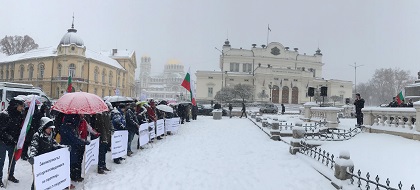
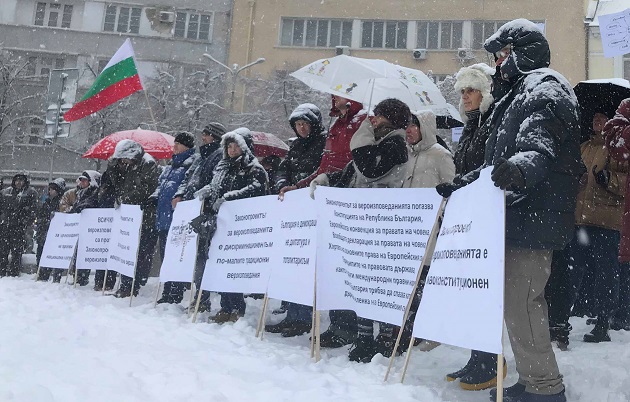
Under the snow, evangelical Christians protested in Sofia for the seventh Sunday in a row against amendments to the Religious Denominations Act, December 16. / Vlady Raichinov
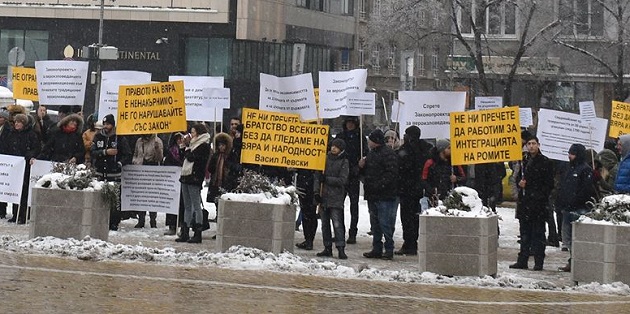
On their eight day of street rallies, Evangelical Christians crowded up in front of Bulgarian Parliament praying for God’s interference in the legislative process, December 21, in Sofia. / Vlady Raichinov
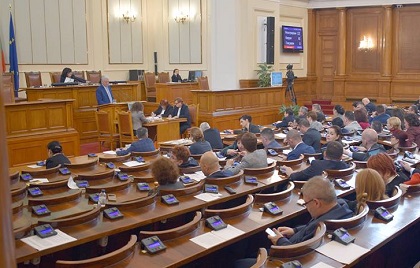
In their last session for 2018, MPs finalized Bulgaria’s Religion Act amendments / Vlady Raichinov
-No minimum requirement membership for registration of a religious group. (In various versions of the law this figure was 300 or 3,000 members.)
-No ban for religious schools of minor religions. International theological certificates will be recognized. (According to the original intent of the lawmakers, only faith groups over one percent of the population could train their clergy.)
-No filter for international donations. (The preliminary provisions restricted religious donations from outside Bulgaria only for buildings and social work, and only via permission from the state Religious Denominations Directorate.)
-Worship services are allowed outside of designated buildings. (In the first draft, no liturgy was to be allowed outside of churches and temples.)
-Foreigners are allowed to hold services without special permission. They will only need to inform the state Directorate of Religious Affairs about their activity. (Originally, the plan was to limit their ministry only after written permission by the state Directorate, and only accompanied by a Bulgarian ordained minister.)
-Limitations on sermon content were not accepted. Faith groups will be allowed to publish and distribute their own literature according to their own teachings. (The first draft installed a ban over preaching doctrine or distributing literature that might cause disagreements.)
-Buildings that are designated for religious purposes (liturgy, worship service) can be registered into a national registry. This is not mandatory. If they are registered, they are eligible for tax deductions. (In the first draft, there was an obligatory requirement for every single denominational property to be registered.)
-The Religious Denominations Directorate will not be responsible to review faith groups for possible radical teachings. (Originally, the document had piled up a tremendous responsibility on this governmental group consisting of a handful of experts to monitor sermon content, literature and doctrine for possible terrorist threats. There were no planned competencies for the Directorate how to do all this work.)
The one issue that was not pulled out was the method of calculating eligibility for state funding for religious groups. The final version of the Act installs availability of governmental subsidy for registered faith groups according to the number of their self-identified followers at the most recent national census. Millions of Euro will be provided annually by the secular state budget for the Eastern Orthodox Church (76% of the population) and the Muslim religion (about 10%). If the government can afford it, more money will be given to the Orthodox religion. (By constitution, Bulgaria is a secular state, but the Eastern Orthodox Church is specifically named “traditional” religion and receives various privileges like state funding, media access, social acceptance and national holidays, among others.) After the December 21 voting, the Bulgarian Evangelical Alliance issued a statement expressing relief over this victory, as well as gratitude and joy because of the churches’ strong reflex for social justice and religious liberties. Due to the lawmakers’ initiative and the Christians’ response with prayer intercessions, legal protest statements, international pressure, public rallies and vigils, and a lot of media coverage the BEA wrote to its member denominations that we have seen several important developments in Bulgarian Evangelicals’ life: a Church that is awake and spiritually alert; unity between pastors from various denominations; focus on prayer and fasting for freedom of belief, of speech, and of assembly; Bibles given out to Bulgarian MPs; recognition by the authorities; massive support from the global Christian community; positive international pressure over Bulgarian politicians; Evangelicals’ access to media outlets. Alongside with the excitement for their political victory and the cancelled law restrictions, however, Bulgarian Christians are also provoked to be alert for other upcoming battles. There are points of concern that cannot be ignored. In the end of January, the BEA office is setting up a special meeting of its member denominations to discuss how the new format of the Religious Denominations Act would impact church life, and whether it still contains provisions that might impede religious and human liberties. The fact that Evangelical Christians are taking the win today, does not mean they will be turning a blind eye the government’s ambition to impose its control over areas like church life or family life in the future. New issues lurk around the corner, and the church will soon be called to respond with firmness, unity and a renewed commitment to social justice and Biblical righteousness. Today, a month after those tremulous events, Bulgarian Evangelicals express gratitude to the Lord for this amazing victory. Such an unprecedented change of heart among nearly all political parties only comes to show that invisible forces were set in motion and the battle was led both on a visible and on an invisible plane. In early January, the Bulgarian Evangelical Alliance held its traditional Prayer Week. Between January 7 and 13, hundreds of Christians met every evening in a different church building, expressing their spiritual joy for serving an almighty God. For the 14th year in a row, this Prayer Week opens the year with a time for intercession: for the persecuted church, for strong families, for physical healing, for the nation’s government, for the young generation, and for the furthering of God’s Kingdom.