Reaching the open generation  

Reaching the open generation  
Dan Randall is married to Marina and they have a beautiful daughter called Grace. Together, Dan and Marina are the core team leaders for Nxt Move Europe and part of the global NxtMove community. As part of that role they serve the European Evangelical Alliance helping to facilitate the EEA’s Youth and Young Adults network – something Dan and Marina are really excited about. They are also part of the leadership of the European Youth Ministry Network, which is a long-standing group of friends who seek to gather youth leaders from across Europe, to train and equip them and to think missionary about how to advance the gospel in the next generation. When they are not travelling Europe, Dan and Marina help lead a local church called Life Church Lancashire – Marina is the young adults and students pastor and Dan helps lead the church generally through vision and strategy. Dan is also involved with a business called ‘The Way Studios’ which funds a ministry called „The Way UK“, which is mainly active on social media to try and reach youth and young adults particularly. Currently, they are reaching about 5% of the young adults and young people in the UK aged 13 to 24 with gospel conversations. 

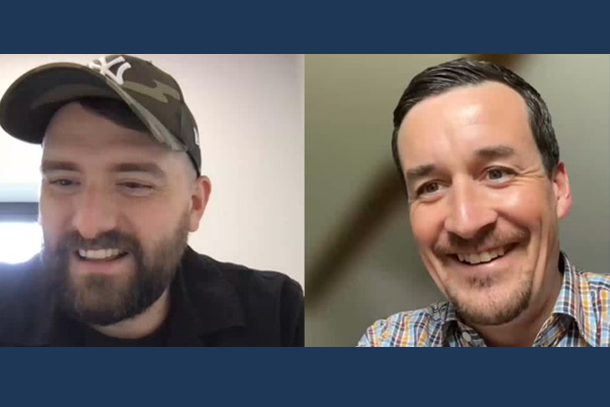
Matthias Boehning, EEA’s Operations Manager, has met Dan Randall for a virtual interview ahead of this year’s General Assembly to talk about the partnership between Nxt Move Europe and the EEA as well as some key insights into God’s work in the next generation. 
Matthias: You are thankfully serving the EEA by facilitating the Youth and Young Adults Network. How does this partnership with the EAA increase your capabilities at NxtMove Europe and how does it add to what you have been doing previously?  
Dan: At Nxt Move, we are very much a community of like-minded leaders of leaders who are seeking to see the trajectory of Christianity accelerated in the next generation. And so we want to come alongside and serve the Evangelical Alliances of this world. In our case this means mainly the EEA, but also the EEA’s networks, affiliated organizations and its movements. Together we want to explore how we can see it happen, how we can see fresh expressions of church in different ways reaching younger generations. We love and recognize the history and the legacy of beautiful institutions like the European Evangelical Alliance and the National Evangelical Alliances across the region. We see our cooperation as a two-way street. On the one hand, we seek to serve and bless. On the other, we want to explore how we can maybe create new ways and spaces to take younger leaders who are looking for community on a journey. Maybe they don‘t see how they can potentially fit into traditional institutions. But we want to draw things together, connect things up and lean on the wisdom and expertise of the Alliances through so many years. We want to bring things together to see how we can create new dynamics in new spaces. We find ourselves in a post-pandemic world with war going on in Europe and further conflicts on its fringes and a financial crisis in many parts of this continent. All these different things affect all of us. But it’s crucial to understand that they ultimately have a bigger effect on the younger generation. Thus, we are seeking to see how Jesus is the hope for the next generation just like he is the hope for all humanity. How can we find new ways to see him shared with others? How can we see leaders raised up who can plant different expressions of church and community? How can we embark together in partnership on all sorts of new things to see the gospel advance on this continent?  
Matthias: You are an expert for God’s young squad. In your perception, in which state are young people in Europe? What are some of the characteristics of the next generation? And what are some of the stats you and your team work with?  
Dan: First of all just for context: When we say „Gen Z“, we are talking about those born after 1995 up to about 2010. „Gen Alpha“ are the ones born 2011 onwards. Many people have said about these generations, they are „post-christian“. I personally think we are beyond that. In fact, we are in a place where actually these generations are „pre-christian“.  For some people it is scary to look at census results and realize there are less Christians than before in terms of less people ticking a box to say they are Christians. To be honest, that does neither scare me nor does it concern me. On the contrary, I see it as the greatest opportunity we have had since the reformation. What I mean by that is best captured by the phrasing from the Barna research group who call these young people the „open generation“. They are like a white blank piece of paper.   
Gen Z are now adults in the workplace in their early 20s influencing decisions. And actually, they are more open than ever and we have an opportunity. The reason is: they are not dechurched, they are unchurched. They are not post-christian, they are pre-christian. Some people see something like a negative secularism that is increasingly sweeping throughout Europe. In my view, this is actually an opportunity because people don’t know who Jesus is and they don’t have preconceptions of him. So it’s the best time to share Jesus in his fullness. 
In our work, Isaiah 54:1-3 feels like a prophetic image of Europe: „Sing, barren woman, you who never bore a child; burst into song, shout for joy, you who were never in labor; because more are the children of the desolate woman than of her who has a husband,” says the Lord. “Enlarge the place of your tent, stretch your tent curtains wide, do not hold back; lengthen your cords, strengthen your stakes. For you will spread out to the right and to the left; your descendants will dispossess nations and settle in their desolate cities.“ (NIV) Actually, this is a pretty good picture of Europe right now. There is something about to be birthed. We need to come together and strengthen the stakes. We need to put things in place in unity and in collaboration, but also believe big. We need to create space where the next generation can grow and develop in the fullness.  
Looking at some of the stats, we know that 38% of Millennials are leaving the Church and they’re not going back according to One Hope‘s Global Youth Culture research. The same study states that 52% of teens globally say they never read religious scripture on their own. Only 11% of young people in Europe are committed to follow Jesus and only 5% are really following Jesus in their day to day life according to the Open Generation research by Barna. So there are multiple challenges and barriers across different parts of Europe. But there is also a huge opportunity among the young generation: 52% of the globe is under the age of 30. Obviously, that figure will be slightly different in Europe since we have an older population here, but young people are still enormously important for the Kingdom of God. 80% of Christians made the decision to follow Jesus before the age of 18. That statistic has not shifted for decades if not for centuries. It’s mainly in younger age that people are coming to faith. And how do they come to faith? Mainly through other people but increasingly also through the word of God. According to the Talking Jesus research from 2022, 60% of 18-24’s know a Christian and 38% of 18-24’s said that the Bible was the top influence in them coming to faith. Back in 2016, this was just 15%. So scripture is higher up – even higher up than growing up in a Christian home. So there is opportunity. I think now is the time more than ever before for us to get out there and engage the younger generation, share the good news of Jesus with them in a full way and not think about what they might say. Young people these days want something real, radical, life-changing and authentic.  
Matthias: Could one say – to stay with your picture – if the current generation is kind of a blank page, the post-Christians before were more of a burnt page? 
Dan: I would say Gen Z and Gen Alpha are white blank pages maybe with a little bit of burn around the edges because of some of the human sexuality and gender conversations that have gone on. So the burn comes from what they think the church hates, but younger generations are looking for authenticty on all matters, so now is the time more than ever to be clear on distinct evangelical values as the Church on marriage, ethics, and morality. They are blank page because they are a pre-Christian generation, maybe the greatest opportunity since the reformation?! Millennials are more of a bridge: We are not so sure, because we have had mixed experiences. Gen X, however, is definitely burnt by the church. It is a very dechurched generation.  
Matthias: In traditional evangelistic trainings you learn how to share your faith and respond to and counter prejudices that people might have about faith and the church. In view of the „blank page generation“ or „open generation“ is that still relevant at all? 
Dan: I think, there are a few things going on. First of all: They are open. They are spiritually hungry. They are spiritually aware. They are engaging with spiritual things and I say „spiritual things“ deliberately in the broader sense meaning beyond Evangelical Christendom. Rather like anything that seems spiritual.  
In my view, the biggest challenge we have with the young people who are Gen Z and Gen Alpha with regards to peer evangelism among friends and also with regards to peer discipleship is this „post-truth“ culture idea. I personally don’t see it as „post-truth“, I see it as „own truth“. It’s like one of these pick-and-mix shops that has lots of sweets where you pick what you want. That’s how people are building faith: they take a little bit of this, a little bit of that, a little bit of buddhism and a little bit of this idea they have heard on TikTok. So in the end, I have built my own truth and my own spirituality. Interestingly, there is a great deal of respect for that nowadays. Believe what you want, they say. Build your own truth, mate. But as soon as someone says no, it’s not my truth, it’s the truth, meaning: a bigger truth. That is a problem in the young generation.  
Obviously, we would believe it puts pressure on the younger generation Christians to have better apologetics. Actually, apologetics have always been important throughout time and will continue to be important. But nowadays in reality, experience is top. So the pressure on a young person is much less to have better apologetics and to share faith with their friend by saying: „Let me convince you of Jesus“. No, it’s rather: „Let me invite you to meet Jesus, because he is the way, the truth and the life.“ So when we talk about truth these days, let us invite people to meet, encounter and experience Jesus rather than just focusing on better apologetics in an „own truth culture“.   
In terms of prejudices or barriers I think we as the Evangelical church probably haven’t been good all the time, I am sure we have done it well lot’s of the time, at making sure that people know that Jesus is Good News. The EEA’s line is: „We are good news people!“. In reality, for you and me Covid has been a very small portion of our life. We have a different life experience before Covid. But if you are 20, Covid was a huge portion of your life. I think that is significant in itself. For many young people, there isn’t any good news in society. For a 20-year-old these days there is nothing really good in their lifetime. Personally, I have had lots of good highlights in my life. But they don’t have highlights. And so they bury their head in the sand, whatever that sand looks like: TikTok, the Kardashians or whatever it is. It’s upon us to bring them hope and good news. Come on, we don’t have to invent good news. We have great news and a strong idea of real hope for the future. It was interesting, when the Queen of England died. A lot of people were like: „Wouldn’t it be great to live to that age?“ But Gen Z doesn’t seem to be asking that question. They seem to be asking: „Will the planet still exists when I’m 40?“ Not: „Will I live until I’m 90?“These young people need help for the future. And that is where the good news really matter. 
Matthias: In different missiological reports and studies it is always said that the diaspora church is shaping Europe more than anything else. Whereas many traditional majority churches are stagnant or even shrinking, diaspora churches from Ghana, Nigeria and other places are growing, expanding, and planting new locations more than any other denomination across the continent. Is this something that also shapes the young church on the continent? Is the next generation of European Christians more diverse? 
Dan: The diaspora communities in Europe are huge indeed. Just imagine that 15 million refugees from the Middle East and North Africa are living just in France. So the diaspora church is huge, too. Whereever the church is growing fastest these days, it is generally not solely European white. It’s definitely at least mixed.  
Matthias: What do young Christians care about these days and what can the „older church“ learn from them? 
Dan: Let’s stay with the diaspora for a moment. Migration is one of these contentious issues which very quickly become heated socio-political conversations. I have heard some Christians saying: we need to be helping people out of situations, where they are being persecuted or bombed or genuinely have good reasons for fleeing and leaving their country, but there has to be a line drawn somewhere. Well, I am pretty sure Jesus would welcome these people. But how do we do that practically as a church? How are we becoming a welcoming church in the midst of European societies that are increasingly making all sorts of restrictive decisions?  
Refugees and climate are probably the two topics that the church could be dealing way more with to help the younger generation see where Jesus‘ heart is on these matters. In the field of climate and environmental protection, it’s actually pretty simple: God created the world and we are meant to steward it well. I mean, how can older Christians have an issue with young people being passionate about the climate? In my view, it is one of the easiest things to connect the dots on. Also, there is a fork in the road moment, because young people are passionate about this matter and they see at the same time, that the church is not very passionate about it. So what they are going to do is to detach themselves from anything that has to do with Jesus. And they will go off, be passionate about the climate and the church will have lost them. Whereas, actually as a church we could rather invite them to come and help lead us in this area saying: „Actually you are more clued up on this and you are more passionate about it. What we will show you, is that this actually is right at the heart of who God is.“ Climate doesn’t need to become the main thing in any church. Because that is a problem, too, if sometimes we become a one-issue-based Church. That’s not healthy, because Jesus is for everyone and is about everything. But Jesus really cares about it.   
In the end, the question remains: what is the church’s voice in these difficult questions? And what would Jesus have to say about them? To be honest, I think the younger generation is sounding a bit more like Jesus on these matters, than sometimes maybe some of the older generations. I guess, the ultimate question is: „What does Jesus care about?“ What the younger generations are shouting and what they are passionate about is actually in the DNA of us as the church. So how do we help them connect to the church? Because they are at a fork in the road:  they will go on being passionate about things and if they see that the church doesn’t care or doesn’t even want to engage in a conversation, even if there’s disagreement, why would they be part of that church? These are the questions we have to ask! 
Matthias: What is your „one thing“ for 2024? What do you want to achieve or see coming?  
Dan: We want to develop a community of leaders who support each other, invest in each other, encourage each other and develop together a vision and a strategy for Europe how we reach and empower the next generation.  
Matthias: What can others do to support your one thing?  
Dan: Pray for the next generation in Europe. Connect with us, if you would like to hear more. And start a conversation. We’d love to help people run what we call „NOW“ conversations: „Not On Our Watch“. How do we actually really discuss measures countering the sharp decline in engagement with Christianity among younger generations in Europe? And how do we see the trajectory of Christianity and the next generation? So in summary: Pray, connect and start a conversation.  
In some ways, the upcoming EEA General Assembly will be like a bigger and broader „NOW conversation“. We will be asking: „What is?“, „What could be?“ and „What now?“. So we travel through reality (existing fruit and present challenges) to dream and a prophetic perspective on what God is up to all the way to what we’re going to do about it together. Often, this last question is the weakest point of most conferences: the actionable items. In Sarajevo during the EEA General Assembly, we will make sure we have a solid understanding at the end on what we will be doing about what we have discussed at the GA.  
  
If you want to find out more about EEA’s Youth & Young Adults network, check out their network page  

Latest Posts

Receive the EEA newsletter!