As Easter approaches, we find ourselves—personally, spiritually, and collectively—standing at a crossroads. Lent invites us to pause, to look honestly at our lives, and to turn again toward God. This season of reflection meets a world marked by deep uncertainty. Wars continue to destroy communities and uproot millions. Political tensions reshape societies. Climate change confronts us with fires, floods, and fragile futures. Beneath these crises lies a growing awareness that we are living through a moment of profound transition—a time of decision.
Into this moment, Luke 22:39–53 speaks with fresh urgency. In Gethsemane, Jesus faces his own crossroads. His prayer—“Father, if you are willing, take this cup from me; yet not my will, but yours be done”—reveals both anguish and obedience. He does not flee suffering but entrusts himself fully to the Father. At the same time, he urges his disciples, “Pray that you will not fall into temptation,” yet they struggle to stay awake.
This tension mirrors our own experience. In a world saturated with noise, crisis, and relentless information, weariness comes easily. The temptation is rarely dramatic; it is the quiet drift, the slow dulling of our spiritual attention. Lent calls us back to wakefulness—to prayer, discernment, and renewed attentiveness to God.
Because we, too, stand at a crossroads.
Will fear lead us to withdraw, or will faith draw us into courageous engagement?
Will division breed suspicion, or will we choose reconciliation?
Will suffering harden us into resignation, or move us toward compassionate action?
Europe feels these pressures acutely. Debates about identity, migration, and values shape public life. The climate crisis challenges our stewardship. War on our continent reminds us how fragile peace can be. Yet in Gethsemane—and in the events that follow—Jesus shows another way. When confronted by an armed crowd, he refuses violence. When a sword is drawn, he heals the wounded. Even in injustice, he embodies the kingdom: not domination, but surrender; not force, but sacrificial love. This is the way of the cross.
For Evangelicals in Europe, this moment is both demanding and full of possibility. We may find ourselves in a more marginal position, yet it is often from the margins that the clearest witness emerges. Our calling at the crossroads is not to grasp for influence but to remain faithful—to be a people of prayer, hope, and love.
There are real signs of encouragement.
Recent Learning Communities in Central Europe and the Balkans have been deeply energising. Leaders gathered with openness and trust—listening, sharing, and discerning God’s work in their regions. These encounters are strengthening relationships and shaping a shared sense of direction.
A similar global perspective emerged during my visit to the Movement of African National Initiatives (MANI) consultation in Abidjan, Ivory Coast. There, a compelling call was voiced: “Go North.” African churches increasingly sense a responsibility for Europe, and diaspora communities are embracing their role within the societies where they now live. Mission today truly flows from everywhere to everywhere—and Europe is part of that movement.
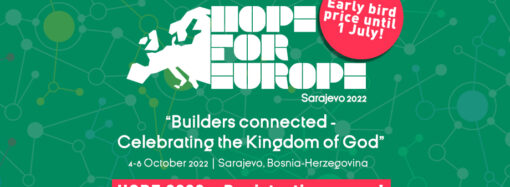
Momentum is also building toward the Hope for Europe Gathering in Golem, Albania, from 5–9 October. Under the theme “At the Crossroads,” leaders from across our networks will come together to listen, pray, and seek God’s way forward. In a time of fragmentation, this gathering is a sign of unity; in a time of uncertainty, an expression of hope.
The road to Easter reminds us that the crossroads is never the end. The One who knelt in the garden, who walked the way of the cross, and who rose again goes before us still.
Rev. Jan Wessels (MTh)
General Secretary
European Evangelical Alliance