There are two things I have struggled with for as long as I can remember: I never felt fully at home anywhere, and I was never sure I was good enough.
I was born the early 1980s in Georgia into a mixed Georgian-Ukrainian family. Living through the dissolution of the Soviet Union and the rise of nationalist discourse, I was never fully accepted as “purely Georgian.” “Georgia for Georgians” was the driving motto of society. Already in my school years, I would hear from classmates: “Go away, you Russian”—a pejorative at the time. Some teachers would crush my enthusiasm for learning by saying, “You will never think and write like real Georgians.” I remember feeling ashamed of my background, of my mother, and wishing she could be like “all the other moms” at school’s parents meetings.
This shame only deepened when religious identity was added to my ethnic background. When I was nine, my family joined an Evangelical church. Since being Georgian meant being Orthodox, this was not well received by relatives and friends. “Sectarian” was the term whispered behind my back. I didn’t know the term “double vulnerability,” but I lived it. I heard variations of the same message throughout those years: “You won’t get this job because of who you are.” “You cannot marry this person because of your background.” Once someone said, “She’s such a nice girl, but unfortunately not really Georgian, and sadly not Orthodox.” It was a nagging feeling of never being good enough.
Philosopher Martha Nussbaum writes that it is precisely because of vulnerability that human beings have strength, beauty, excellence, and nobility. I tried to fight against my vulnerability by studying hard and striving for excellence. I researched the history of Evangelicals in Georgia to prove we had roots there. I even earned a doctorate in the field. Gradually, God transformed everything I had been ashamed of into sources of strength that could serve the church and society. My experience of marginalization gave me insight into minority religious communities. My cross-cultural background equipped me to navigate complex identity questions. My struggle to belong deepened my understanding of what religious freedom truly means—not just legal protection, but genuine acceptance and human flourishing.
Now, as I move to Belgium to represent European Evangelicals, old fears are resurfacing. Once again, I find myself in a foreign culture, learning a new language, representing Evangelicals amid growing polarization, rising secularism, threats to religious freedom, and the ongoing tragedy of war in Ukraine that continues to test our continent’s unity and compassion. It triggers those childhood memories of feeling like a “second-class” person. But through my past and this new chapter, God graciously reminds me: “We are not of this world; we are citizens of His Kingdom.” Wherever we go and whatever political context we inhabit—whether comfortable or feeling like outcasts—God uses our vulnerabilities to build up His eternal Kingdom, where all citizens can thrive and feel fully accepted.
 The Apostle Paul describes this paradox beautifully: “My grace is sufficient for you, for my power is made perfect in weakness” (2 Corinthians 12:9). My journey has taught me that vulnerability is not weakness— it is the very thing that allows us to understand those who struggle, to advocate for those without voice, and to build bridges across dividing lines. It is the very foundation from which God builds His strength in us and through us.
 The Apostle Paul describes this paradox beautifully: “My grace is sufficient for you, for my power is made perfect in weakness” (2 Corinthians 12:9). My journey has taught me that vulnerability is not weakness— it is the very thing that allows us to understand those who struggle, to advocate for those without voice, and to build bridges across dividing lines. It is the very foundation from which God builds His strength in us and through us.
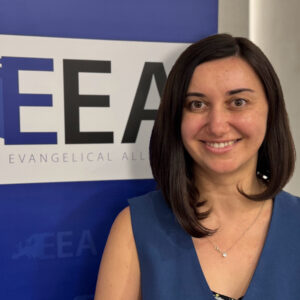
Dr. Tatiana Kopaleishvili, Brussels Representative of the European Evangelical Alliance