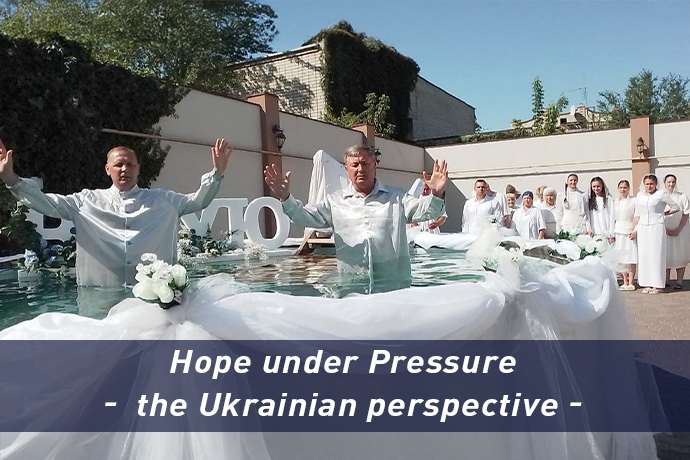
Despite the daily threat of shelling, the Kherson Pentecostal Church had a water baptism on the first Sunday of August for those willing proclaim their faith publicly and to enter into a covenant with the Lord. It was not possible to use the Dnipro River, as it was before the war. The ceremony took place in a specially equipped, festively decorated pool located in a churchyard of Kherson safer district. Dressed in solemn white robes, they were baptized by pastors Oleksandr Babiichuk and Yuriy Kolesnyk.
17 new converts were baptized joining the congregation. Five of them were brought by courageous brothers from the dangerous Karantynnyi Island — across a bridge damaged by KABs (aviation bombs), which is the only transport artery connecting the island to the city. It was a significant test for both – new believers and their drivers.
“There is no safer place and there is no better place then under Jesus’ lordship. We live by His grace and prayers of many saints from around the world. Belonging to His Body makes me feel good, despite the ongoing danger,” says brother in white.
Kherson, Dnipro, Slovyansk, Potlava, Kyiv, Myrnograd – everywhere you find stories like the following one. “Church Without Walls” from Myrnohrad, Donetsk region, led by Pastor Ihor Tunik, established six churches in various cities in eastern Ukraine since the war started. However, after 2022, one by one, they were either destroyed or seized by the occupiers along with the territories.
“It all started because we saw people suffering.” The first churches arose from simple needs: people needed groceries. Even without a car, Ihor Tunik would gather vegetables and deliver them by bus. In time, a group of people gathered and said they wanted to study the Bible together—and so the church life began.
“We started a church in Myrnohrad, then in Pokrovsk. When the war began in 2014, we started helping people closer to the frontline. This is how churches appeared in Avdiivka, Ocheretyne, Novohrodivka, and Shevchenko.” The Myrnohrad congregation was named “Church Without Walls”—a symbol of openness to people, without being fenced off by traditions or other barriers. With the emergence of new congregations, this grew into a missionary movement, and the team became missionaries.
The war has intensified people’s need for spiritual support. Ihor recalls: “Many people wanted to gather every day, so at the beginning of the full-scale invasion, we held daily meetings. It was emotional and spiritual support, and many people came in right off the street. We didn’t know them, but they stayed. Some of them hadn’t slept all night because of the shelling, and they would come to us from 10 a.m. to 12 p.m. to drink tea and talk. We prayed and read something from the Bible there.”
But the situation in the country became increasingly dangerous. “We distributed clean drinking water to people,” Ihor Tunik recalls. “We had a filtration station, and queues of people would stand outside the church building.” They also brought significant humanitarian aid every month.
One day, a regular aid distribution at the Pokrovsk church almost ended in tragedy. It was a five-story building where the church owned one of the premises. “Early in the full-scale war, a missile hit this five-story building. People were injured, and some died on the upper floors. We were scheduled to have a humanitarian aid distribution there in literally half an hour, and we were expecting about 80 people. Thank God the missile didn’t arrive later, because the debris from the upper floors flew all over the yard—death was far too close.”
Later, the occupants captured Shevchenko and Novohrodivka. Other congregations found themselves in increasing danger, and the question of evacuation arose. “We evacuated everyone we could. We took people out and found places for them. In fact, my wife and I were almost the last to leave the city, which was under constant shelling,” says Ihor. One missile landed 250 meters from their home. “But no matter how scary it was, I didn’t leave because I believed that as long as there were believers here, I had to stay and support people, helping them emotionally.” Ihor’s family left when the situation in Myrnohrad became completely unsuitable for life and ministry. Now, the ministry has moved to an online format. In addition, Ihor visits church members in various parts of Ukraine.
“People cry and dream of returning, but for many of them, there is nowhere to return to,” he says. Currently, Ihor Tunik has started a new church in Samara, Dnipropetrovsk region. They minister to the wounded in hospitals, help with basic necessities, clothing, and transportation. They also support elderly internally displaced persons (IDPs) in a local shelter, bringing food kits and a generator.
Friends, these are just a few glimpses into the life of the Ukrainian Church. They are thousands – ordinary people, who follow the calling faithfully. Despite the depth of pain and trials, we affirm: God is alive and active. His Church in Ukraine continues to fulfill its calling—to pray, serve, support the needy, and proclaim the Gospel even in the darkest circumstances. We are convinced that our struggle is not only physical but also spiritual.
Therefore, we sincerely call upon you to join the Global Day of Prayer for Ukraine taking place on August 24, 2025, Ukraine’s Independence Day.
This initiative has been endorsed by the President Volodymyr Zelensky of Ukraine, underscoring the significance of prayer and the unity of the Ukrainian society and government in this critical time.
We ask that on this day evangelical churches worldwide unite in prayer for:
-
an end to the war and the establishment of just peace,
-
protection and restoration of the Ukrainian people,
-
healing of physical and emotional wounds,
-
release of captives and return of abducted children,
-
strength, wisdom, and endurance for the Church of Christ in Ukraine.